


Freshservice has become a trusted system of record for IT teams managing incidents, service requests, and operational issues at scale. Tickets are logged, categorized, prioritized, and tracked with discipline. SLAs are defined. Dashboards provide visibility. On paper, everything looks covered.
Yet many teams still experience missed or delayed responses when incidents truly matter, especially after hours.
The gap isn’t in ticket creation. It’s in what happens next.
Ticketing Is Not the Same as Alerting
Freshservice excels at capturing and organizing incidents. But incident visibility is not the same as incident ownership.
Consider a common scenario:
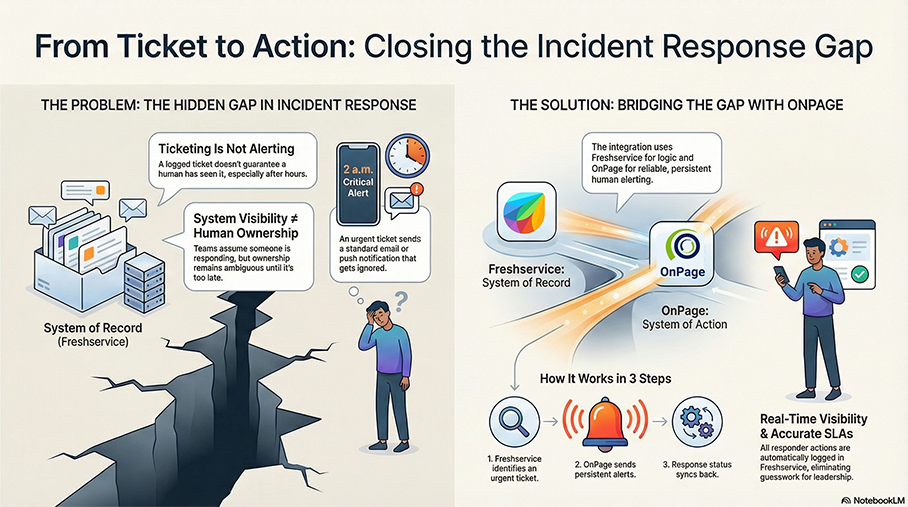
A customer opens a Priority: Urgent ticket at 2:17 a.m. related to VPN access or identity authentication. The ticket is correctly logged in Freshservice. An email notification is sent. A simple push notification may fire on Freshservice mobile app. But no one is actively watching the service desk dashboard at that hour. The email lands in an already noisy inbox. The push notification looks the same as dozens of other app alerts on a phone in sleep mode. From a system perspective, the incident exists. From a human perspective, no one has actually seen it.
This is the distinction many teams overlook: Ticketing records incidents. Alerting mobilizes people.
Visibility vs. Ownership in Real-World Operations
Most service desk leaders don’t struggle with knowing incidents exist. They struggle with knowing whether someone is actively responding, before SLAs are breached or business impact escalates.
Without a mechanism for human acknowledgment, teams rely on assumptions:
-
“Someone must have seen it.”
-
“If it was urgent, they would respond.”
-
“The dashboard shows it’s logged, so it’s being worked on.”
In reality, ownership often remains ambiguous until it’s too late. This ambiguity is amplified after hours, when on-call engineers are not actively monitoring dashboards and notifications must compete with personal apps, email fatigue, and phone settings (silent mode/DND accidentally turned on during oncall).
System of Record vs. System of Action
This is where the architectural distinction matters.
-
Freshservice is the system of record. The authoritative, single source of truth for tickets, priorities, SLAs, and audit trails.
-
OnPage becomes the system of action. The tool that ensures urgent incidents break through the noise and reach a human (or their backup) who must acknowledge responsibility.
One does not replace the other. They’re meant to work in sync. Together, they close the loop of incident management.

Bridging the Gap with the OnPage & Freshservice Integration
The OnPage & Freshservice integration is designed specifically to address the “last mile” of incident response…the moment between ticket creation and human acknowledgment.
Here’s how it works in practice.
Intelligent Triggering Using Freshservice Workflow Automator
Freshservice remains fully in control of ticket logic. Using Workflow Automator, teams can define conditions such as:
-
Ticket created or updated
-
Category (e.g., Network, Access, Security)
-
Priority or impact
-
Time of day or escalation stage
In some workflows, Freshservice may automatically upgrade ticket severity based on these conditions: for example, when a customer-facing access issue remains unresolved beyond a defined threshold.
Once the severity meets criteria for urgent response, the workflow automatically triggers an OnPage alert. There’s no need for any manual steps here, hence requiring no additional monitoring.
From Passive Notification to Persistent Alerting
At that point, OnPage takes over execution. Instead of a passive notification, the on-call responder receives a persistent mobile alert on their OnPage phone app, designed to command attention, even when the phone is locked or in Do Not Disturb mode. With OnPage’s incident alerting and on-call management platform, alerts are routed using:
-
On-call schedules
-
User-based escalation policies, or Failover rules if the primary responder does not acknowledge
- Multi-modal alerting mechanism, that includes SMS, phone call and email in addition to push alerts.
The goal of this precision-based alerting mechanism is simple. To reach a person, not an inbox. If the first responder doesn’t acknowledge within a defined window, the alert escalates automatically until someone does.
?si=W5bXwbDumv5LFud4
Real-Time Feedback Back into Freshservice
As the alert progresses, OnPage continuously writes status updates back into the Freshservice ticket:
-
Alert sent
-
Delivered
-
Read
-
Acknowledged
If the responder replies from the OnPage mobile app, that message is synchronized back into Freshservice as a ticket note, and vice-versa. For managers and stakeholders, this eliminates guesswork. Freshservice remains the single source of truth, now enriched with real-time response visibility. Responders no longer need to context switch between platforms to log or track incident activity. Any update made in one system is automatically reflected in the other, in real time.
Why This Matters for SLAs and Leadership Confidence
When incidents are in motion, SLA performance depends not just on fast response, but on accurate, timely documentation. Because all responder actions and replies are automatically synchronized into Freshservice in real time, SLA clocks are no longer impacted by delayed updates or manual follow-ups. Teams gain accurate response and resolution timestamps without relying on responders to duplicate work across systems.
For managers and stakeholders, this eliminates guesswork. Freshservice remains the single source of truth—now enriched with real-time responder activity and visibility. Leadership can confidently assess SLA performance knowing that response and resolution metrics reflect what actually happened during an incident, not when updates were manually logged.
A Small Cost to Protect a Large Investment
For most teams, OnPage costs less than a few cups of coffee per user each month, under $28 at the high end. That incremental spend protects:
-
SLA performance
-
Customer trust
-
On-call accountability
-
Confidence in Freshservice as the operational backbone
In contrast, a single missed critical incident can cost far more in churn, downtime, or internal escalation.
Completing the Incident Response Loop
Modern incident management doesn’t stop at ticket creation. It ends when a human has acknowledged responsibility and taken action. By pairing Freshservice’s structured ticketing with OnPage’s purpose-built alerting and escalation, teams move from visibility to ownership, and from passive notifications to reliable response.
For organizations that rely on Freshservice today, this integration closes the last mile of incident response. Teams interested in evaluating the integration can trial it with their on-call workflows and see firsthand how acknowledgment-driven alerting changes response outcomes. Feel free to reach out via our contact us form and we’d be happy to set you up with an OnPage instance. OnPage Contact Us – T: +1 (781) 916-0040 | E: [email protected]
About The Author


