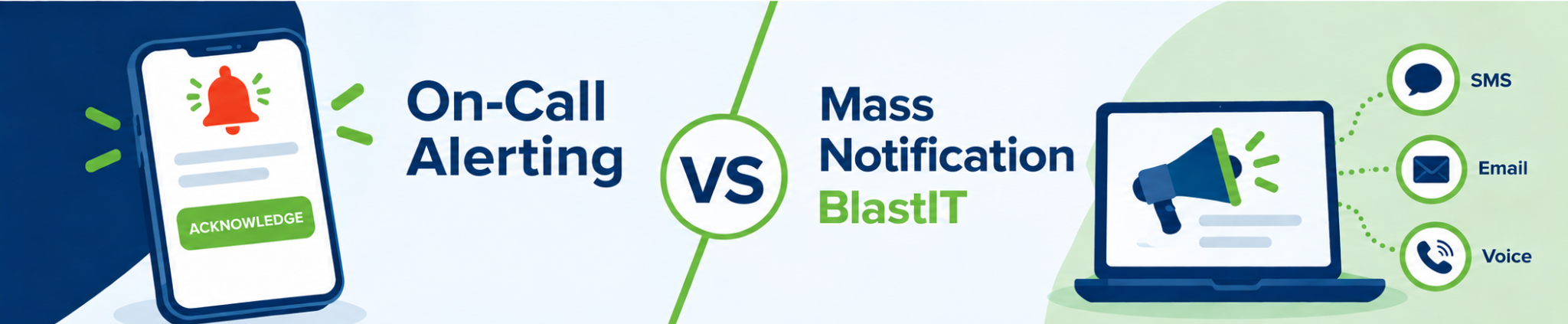
When an urgent situation occurs, organizations need more than a way to send a message. They need a communication strategy that considers who needs to receive the message, whether they need to take action and how quickly they need to respond. This is where the difference between on-call alerting and mass notification becomes important. A … Continued
A missed page at 2 a.m. can turn a minor service degradation into an hours-long outage, an SLA breach, and a costly customer-trust problem. For IT operations, SRE, and DevOps teams, the tool that decides who gets alerted, how, and when someone stops the escalation is a critical piece of infrastructure. This guide helps IT … Continued
IT Ops teams face two failures that pull in opposite directions: responders interrupted so often that they stop reacting, and a truly critical alert lost inside that same flood. Alert noise and alert fatigue describe those two problems, and treating them as one usually makes both worse. This article shows how to reduce interruptions without … Continued
A single incident can generate the same alert several times in quick succession. These duplicate alerts create unnecessary noise and alert fatigue, and make it harder for on-call teams to focus on the issue that needs their attention. OnPage Alert Deduplication reduces repeat notifications while preserving visibility into every incoming alert. When matching alerts arrive … Continued
A missed alert at 3 a.m. can turn a minor outage into a full-blown SLA breach. For IT Ops teams and MSPs, the on-call alerting tool you choose directly affects how fast you detect and resolve critical incidents. That decision just got more urgent, because one of the most popular tools in this space is … Continued
On-call duty is a high-stakes reality in modern IT and digital ops teams. While essential for ensuring system reliability, the chronic stress it creates doesn’t have to be a given. On-call burnout is a serious threat to your team’s well-being and your organization’s performance, but it isn’t inevitable. It’s a systemic problem, not a personal … Continued
The chaos of manual on-call management is a familiar story for many IT Operations teams: frantic phone calls, confusing spreadsheets, missed alerts, and frustrated engineers on the verge of burnout. This reactive approach doesn’t just strain your team; it risks service-level agreement (SLA) breaches and customer churn. As of June 2026, switching to automated on-call … Continued
The world of IT incident response is no longer just about getting an alert. As systems grow more complex, teams need tools that not only notify them of a problem but also help them solve it quickly. In this evolving landscape, two names dominate the conversation: PagerDuty, the established enterprise leader, and incident.io, the modern, … Continued
With Atlassian set to sunset Opsgenie in 2027, the clock is ticking for thousands of IT, DevOps, tech support and MSP teams. If you’re one of them, you’re now faced with the urgent task of finding a replacement for your critical alerting and on-call management platform or opt into purchasing Jira Service Management. While this … Continued
As of May 2026, engineering and IT teams are aggressively evaluating pagerduty alternatives due to compounding licensing costs and stagnant feature sets. Open-source solutions promise freedom from vendor lock-in and zero software costs, but self-hosting your incident response stack introduces a dangerous new risk: who pages the on-call engineer when the pager system itself breaks? … Continued