


In today’s digital world, customer expectations are at an all-time high, with demands for instant support, flawless user experiences, and constant service availability. This environment of heightened expectations pushes organizations to innovate and streamline their operations continuously. Ensuring seamless service delivery hinges on the ability to detect and resolve issues swiftly, whether they are server crashes, software bugs, or unexpected outages.
The backbone of maintaining uninterrupted services lies in effective incident management. Monitoring tools identify disruptions, but it is the IT Service Alerting (ITSA) tools that drive rapid, targeted responses to high-severity incidents. Opsgenie is a well-known player in the ITSA market. However, recent reports of outages linked to its parent company, Atlassian, have cast a shadow over its reliability. This situation prompts a critical evaluation: is the integration with Atlassian’s suite worth potential reliability risks? If an alert system fails during a crisis, it cannot be trusted when it matters most. The reliability of your alerting tool is essential to keeping services running without interruption.
This article covers the top Opsgenie alternatives for teams evaluating their incident alerting options, comparing tools that route critical notifications to on-call responders based on schedules, roles, and escalation policies. We’ll be exploring the following tools:
- This blog compares the top Opsgenie alternatives, including OnPage, PagerDuty, Splunk On-Call, xMatters, and Datadog Incident Management.
- We compare vendors including OnPage, PagerDuty, Splunk On-Call, xMatters, and Datadog Incident Management.
- While some vendors offer comparable solutions, they can be prohibitively expensive or overkill for the customer’s use case.
- Alerting tools from large enterprise vendors can also be costly, and incident management is often deprioritized in favor of their broader product lines.
- Because incident alerting and on-call management are business-critical, the right vendor needs a proven track record of uptime, reliable innovation, and strong customer support.
Opsgenie
Source: G2
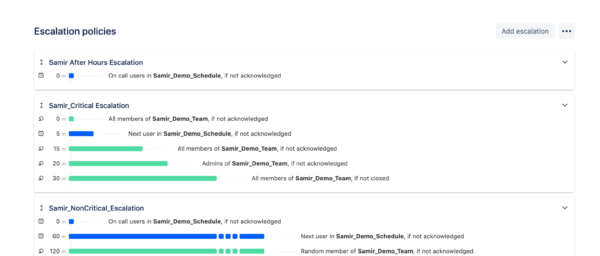
As we move into our list of alternatives, let’s give a fair shake to Opsgenie, understand what it brings to the table, and discuss why customers may want to seek other alternatives. Opsgenie is an incident management platform designed to ensure critical alerts are never missed. It enables teams to schedule on-call rotations, manage escalations, and quickly respond to incidents by notifying the right people at the right time. Opsgenie integrates with a range of monitoring and collaboration tools to help teams maintain system reliability and uptime.
Opsgenie Features
- Customizable alerting rules, escalations and on-call schedules to ensure the right people are notified
- Detailed timeline to track incident activities and responses
- Post-event reports to help teams improve processes
- On-call scheduling to manage duties and rotations
- API and webhooks to support custom integration
Opsgenie Cons
- Integration Issues with Observability Tools
Some users have reported on Reddit that they face challenges connecting Opsgenie to modern observability platforms, which can delay incident detection and slow down response times — a key reason teams look for Opsgenie alternatives with stronger integration support. - Outdated User Experience
The platform has been described as having an outdated interface, which can slow down workflows and reduce team satisfaction, particularly for organizations used to modern incident management tools. - Cumbersome Holiday Overrides
Making schedule adjustments for holidays or shift exceptions can be complex and unintuitive. - Fragile On-Call Rotations
Adding new team members to the rotation can disrupt existing configurations, creating coverage gaps that put incident response at risk.
Pricing

Source: Opsgenie
Opsgenie has four pricing tiers: Free, Essentials, Standard, and Enterprise. Essentials costs $9.45 per user/month but includes only limited features. Standard adds unlimited alerting and incident management for $19.95 per user/month. Enterprise is the top-tier plan at $31.90 per user/month.
Opsgenie Alternatives
OnPage

The first platform we would like to showcase is our solution, OnPage. OnPage routes critical incident alerts reliably to the right on-call technician, based on schedules, roles, and escalation policies. Teams across IT, MSPs, SRE, network and database operations, and cybersecurity use it to coordinate incident response quickly, without the communication gaps that slow remediation.
OnPage reduces alert fatigue and tech burnout by automating routing so engineers only receive the alerts that require their attention.
Beyond on-call scheduling, routing rules, and escalation policies, OnPage includes several features that set it apart from other incident alerting platforms:
- Contextual alerts: Adding context to an alert ensures the incident is actionable. By creating actionable alerts with detailed information, IT teams can positively impact their mean time to detection (MTTD) and mean time to resolution (MTTR).
- Distinguishable alerts: Not all alerts are created equal or need the same level of attention. Some alerts are low priority and can be handled during normal business hours, while others are high priority and require an immediate incident response. Filter low-priority alerts so they do not wake up engineers overnight.
- Keyword-based alerting: Trigger contextual, intelligent mobile alerts based on specific words found in tickets. If a string or word matches pre-set conditions, an OnPage alert is triggered and sent to the on-call responder. If conditions are not met, the on-call responder will not be disturbed.
- Secure two-way messaging: OnPage’s alerting app enables engineers to securely message each other. Incident teams can enhance collaboration and break down silos without security concerns.
- Escalations and Round-Robin Assignment: Configure escalation groups to notify responders in a defined sequence, automatically routing alerts to the next person in line if the first responder does not acknowledge. The same escalation group can also be enabled for round-robin distribution to help evenly rotate alert ownership across team members.
- On-call scheduling: Use digital on-call schedules to create an equitable after-hours workload. Based on schedule configurations, OnPage will only alert the assigned or tasked on-call engineer.
- Reporting insights: Post-incident reports provide insight into the IT team’s incident response performance. Detailed reports allow teams to re-strategize for future IT-related incidents and prevent recurrences.
- Visibility into on-call schedules: Gain access to your schedules and your team’s schedules on the phone app.
- 24/7/365 customer support: Gain 24/7/365 access to US-based customer support.
OnPage Pricing
Let’s now move on to addressing the elephant in the room: pricing. The vendors discussed on this blog can’t match the value OnPage offers for the price. We’ve consistently delivered cutting-edge innovations without increasing our prices over the past five years. Unlike other vendors, OnPage maintains transparent pricing and subscription levels. You’ll never receive surprise invoices based on usage; what you agree to upfront is exactly what you’ll pay. Plus, teams can try out OnPage for free. Our pricing information can be found here: https://www.onpage.com/pricing/
OnPage Integrations
OnPage integrates with over 200 tools, including chat applications (Microsoft Teams and Slack), IT service management and ticketing solutions (ConnectWise, ServiceNow, Autotask), Salesforce, and cybersecurity and monitoring platforms, with support for SSO and Active Directory from multiple vendors. These bi-directional integrations are continually updated to reflect the latest versions and capabilities, and are fully supported by OnPage’s technical support team.
OnPage Product Development
OnPage is known for its flexibility with development requests. Unlike many vendors in the market, we prioritize customer needs and are committed to making meaningful enhancements to our product. If a customer requires a feature that significantly improves their process, we make it a priority in our development pipeline. Rest assured, your requests won’t be ignored—they are thoroughly considered in our weekly product strategy meetings. As OnPage is central to our operations, we consistently update and enhance it, rather than simply fixing bugs and maintaining it as a revenue source.
We also frequently receive positive feedback from customers who have transitioned from solutions like Opsgenie, praising OnPage’s intuitive scheduling system. We assure our prospective clients that if you can navigate Outlook’s calendar, you’ll find OnPage easy to master.
xMatters

Source: G2
xMatters is another prominent competitor in the larger enterprise incident management solutions market. xMatters offers a single platform for managing an organization’s response to any major event, from IT outages to natural disasters.
xMatters’ cloud-based solution integrates with existing IT infrastructure and applications, providing a unified view of all incidents across the enterprise.
xMatters Features
- xMatters covers incident management from alert to resolution, with notifications, escalation rules, collaboration tools for planning and executing response actions, and analytics for measuring performance against objectives.
- Code-free workflow builder that can help automate key incident tasks.
- Low-code workflows automate time-sensitive tasks and proactively manage incidents, driving innovation at full speed.
- Post-incident reports to drive continuous learning while preventing recurrences.
xMatters Cons
- Overly Complex for Smaller Teams
The low-code workflow builder is powerful, but can be overkill for IT teams that want straightforward alert automation and on-call scheduling without a steep learning curve. - Lack of Escalation Clarity
Users have reported confusion around their position in the escalation order, making it difficult to know if they’re first, second, or third to be contacted during incidents. - Limited Visibility into Schedules via Mobile
Users have reported difficulty accessing their on-call schedules and escalation priority from the mobile app, which can leave responders uncertain about their responsibilities during a shift.
Pricing

Source: xMatters
xMatters offers four pricing plans, including a free version for small teams. The other plans are:
Starter – Comes with the essentials for larger teams, costing $9 per user/month
Base – This is the standard package, coming in at $39 per user/month
Advanced – xMatters’ unlimited option that requires organizations to contact their sales team for pricing information.
Teams looking for OpsGenie alternatives or a replacement for xMatters can try OnPage for free with an enterprise free trial.
PagerDuty

Source: PagerDuty
PagerDuty is an alert aggregation and dispatching service for IT operations and support teams. With PagerDuty, teams can aggregate alerts from monitoring tools, cybersecurity solutions, and cloud platforms on a single dashboard. Teams get a single-pane-of-glass view into all their incidents and can automatically alert the right on-call engineer when a high-priority incident is detected — making PagerDuty a common starting point when evaluating opsgenie alternatives for incident response.
PagerDuty Features
- On-call management and incident alerting with customizable schedules, routing rules and escalation policies.
- Support Runbooks to automate common incident response tasks, actions and processes.
- Provides real-time collaboration for incident response.
- Detailed reports on incidents, response times and team performance.
- Popular integrations with tech tools, but doesn’t support ConnectWise.
PagerDuty Cons
- Unintuitive On-Call Scheduler
The scheduler can be difficult to use, especially for new users. It doesn’t default to a “fully covered” state, which increases the risk of gaps where incidents may go unanswered. - No Support for Alert Attachments
Lacks the ability to send files such as images, PDFs, or voice recordings with alerts, which limits the context available to responders in critical situations. - Missing Bi-Directional Integration with ConnectWise
Does not support full bi-directional integration with ConnectWise, a key requirement for many Managed IT Service Providers. Teams looking for OpsGenie alternatives or PagerDuty replacements often flag ConnectWise compatibility as a deciding factor. - Rapidly Escalating Costs
Pricing can become expensive quickly as teams scale, something frequently mentioned by users on Reddit and other forums.
PagerDuty Pricing
Source: PagerDuty
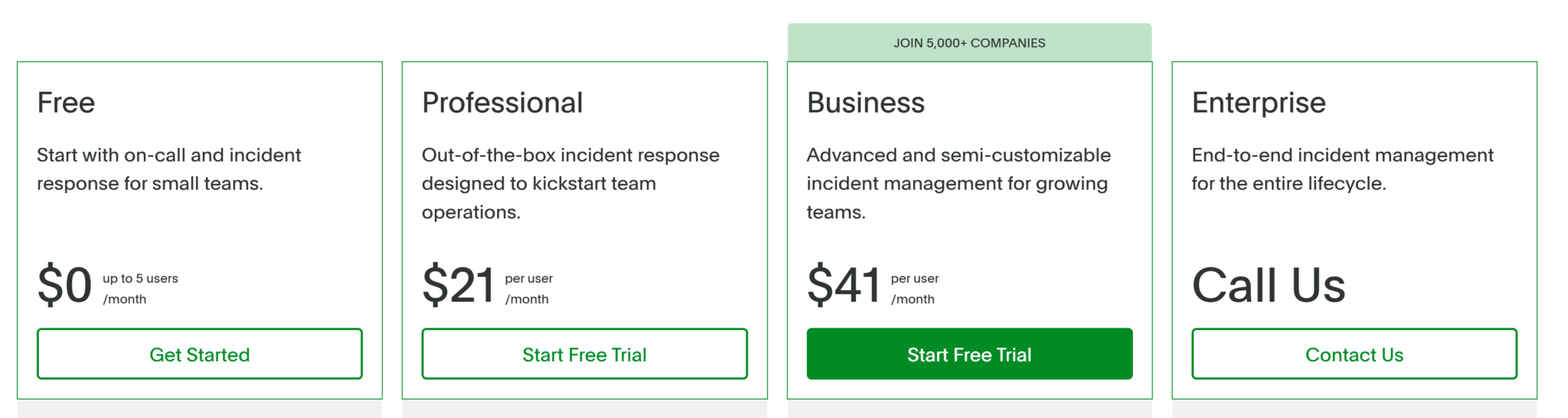
PagerDuty has four pricing plans: Free, Professional ($21 per user/month), Business ($41 per user/month), and Enterprise (custom pricing, contact their team). For teams evaluating OpsGenie alternatives, OnPage offers persistent, alerts-until-read notifications with straightforward on-call scheduling at a competitive price point.
Splunk On-Call

Source: Splunk
Splunk On-Call automates incident workflows to reduce the time it takes to acknowledge and resolve issues. With Splunk, incidents can be delivered to the right person based on their expertise. It also lets teams manage on-call schedules and escalation policies in one place, though teams evaluating Splunk On-Call alternatives like OnPage can get the same scheduling, round-robin incident assignment and escalation features alongside persistent alerting that bypass do-not-disturb settings.
Splunk On-Call Features
- Splunk On-Call uses machine learning to recommend responders and identify similar incidents, helping teams get the right people and information to remediate incidents faster.
- The Rule Engine enriches incidents by attaching resources such as runbooks, articles, and dashboards, reducing the time needed to resolve them.
Splunk On-Call Cons
- Lack of Product Focus
On-call management isn’t a core priority for Splunk, and the platform has seen minimal innovation since its acquisition. - Slow or Impersonal Support
Users have reported that support requests can get lost or delayed within Splunk’s large organizational structure, making it hard to get quick, tailored assistance.
Splunk Pricing
Source: Splunk
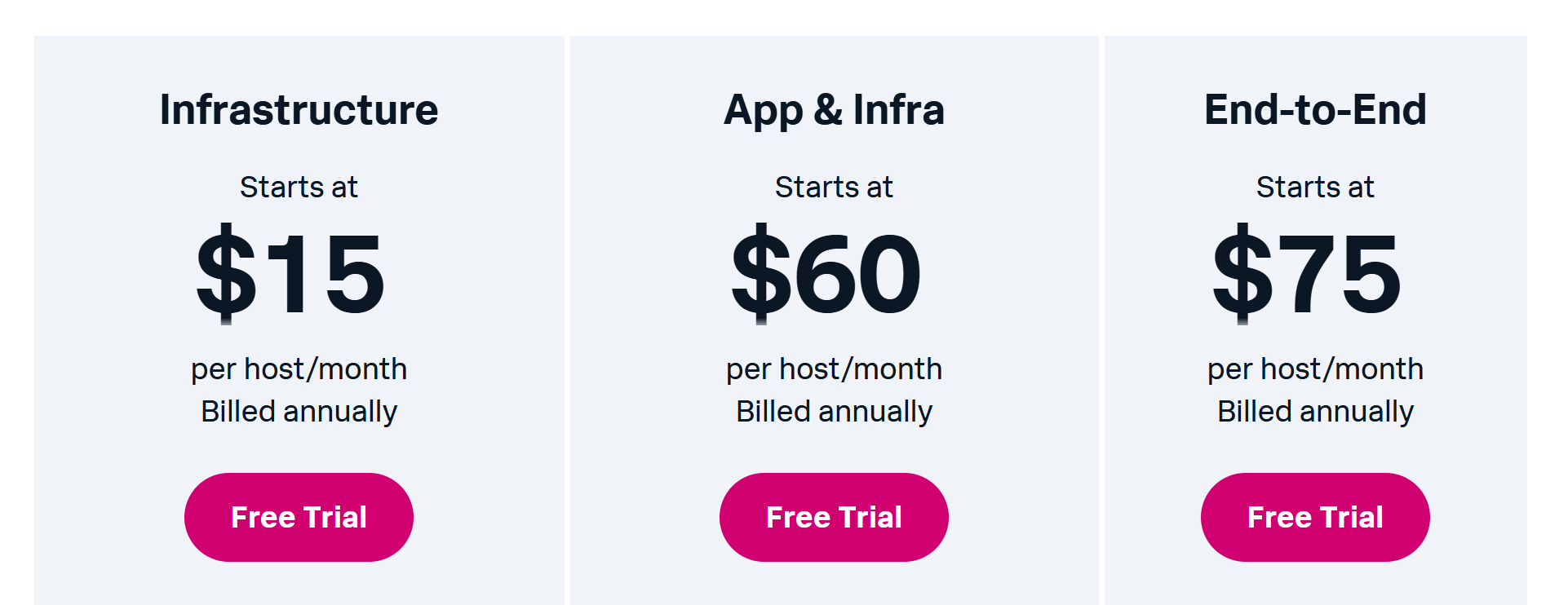
Splunk On-Call has three pricing plans, with no free option. The first is their Infrastructure plan starting at $15 per host/month. Then they have App & Infra which is $60 per host/month. Splunk’s most expensive subscription is $75 per host/month.
Datadog Incident Management

Source Datadog
Datadog Incident Management is an integrated solution that helps teams resolve incidents quickly, from detection through resolution. Built on Datadog’s comprehensive monitoring and observability platform, it offers a seamless experience for managing incidents from detection to resolution.
Datadog Incident Management Features
- Declare incidents directly from a graph, monitor, security signal or from the incidents page.
- Single pane for tracking all active incidents.
- Correlated logs, metrics and traces to identify root causes.
- Integration with Slack to collaborate with key responders.
Datadog Incident Management Cons
- Limited Track Record
Launched in August 2020, the platform has less than six years of real-world use, which means fewer case studies, community resources, and proven reliability compared to more established on-call solutions. - Basic Paging Capabilities
Based on publicly available information, Datadog’s paging features remain basic, lacking the advanced alerting capabilities found in dedicated on-call tools like OnPage, which offers persistent alerts, automated routing, and flexible on-call scheduling. - Perceived Overpricing
A common theme in user feedback is that Datadog’s tools are expensive relative to the value provided—a concern likely to extend to its on-call product.
Datadog Pricing

Source: Datadog
Datadog Incident Management costs $30 per seat/month on its own, or $40 per seat/month when bundled with Datadog On-Call. Teams evaluating OpsGenie alternatives or other incident management tools should factor in these per-seat costs, as they can add up quickly for larger teams.
Open-Source Alternatives to Opsgenie
For teams with the technical resources to self-host and maintain internal infrastructure, open-source incident alerting tools can be a flexible, cost-effective alternative to commercial platforms like OpsGenie. These solutions offer the core functionality needed for on-call management and alert delivery, often without licensing fees or vendor lock-in. Open-source tools do require significantly more hands-on effort to configure, maintain, and secure. They typically lack formal support, polished mobile experiences, and out-of-the-box compliance, which can be critical gaps in high-stakes environments like healthcare or enterprise IT. Still, for the right teams, they can offer unmatched control and customization.
Here are four open-source alternatives worth considering:
Iris by LinkedIn
Developed at LinkedIn, Iris is a scalable incident communication system designed for high-priority alerting. It routes alerts to the right responders and integrates with OnCall, making it well-suited for large-scale engineering organizations, though teams looking for opsgenie alternatives or broader IT and healthcare use cases may find its scope limited compared to platforms like OnPage.
OnCall by LinkedIn
OnCall complements Iris by handling complex on-call schedules, rotations, and escalations. Its native Slack and email integrations give DevOps teams control over how and when alerts are delivered, making it a capable OpsGenie alternative for teams that want to manage their own incident lifecycle.
OpenDuty
Modeled after PagerDuty, OpenDuty is a lightweight, open-source alerting platform and a basic OpsGenie alternative for teams that want simple on-call management without enterprise complexity. It handles basic on-call rotations and escalation rules, and delivers alerts via services like Twilio and SMTP. Best for smaller teams or those seeking minimalism over bells and whistles.
Cabot
Cabot is a self-hosted monitoring and alerting system that includes built-in health checks and integrations with external monitoring tools. It handles detection and alerting in one place, making it an open-source OpsGenie alternative for teams looking for a self-managed solution.
Try OnPage for FREE! Request an enterprise free trial.
Conclusion
We’ve demonstrated the value of adding incident response tools to one’s tech stack in order to keep their digital estate running smoothly. While Opsgenie has strong features, there are several alternatives worth evaluating, including tools like OnPage, PagerDuty, and xMatters. Each has distinct strengths and is best suited to specific team sizes, workflows, and compliance requirements.
Considering Opsgenie alternatives? Try OnPage for Free!

FAQ
About The Author


