
Two approaches to handling urgent requests when accuracy and ownership matter
-
COMPARISON
Answering Services vs Internal Intake, Triage & Escalation Workflows


.png "G2 - High Performer - Summer 2025")
.png "G2 - Fastest Implementation - Summer 2025")
.png "G2 - Best ROI - Summer 2025")



.png "G2 - Momentum Leader - Summer 2025")
.png "G2 - Users Love Us")
Why organizations revisit this decision
Many organizations adopt answering services to ensure coverage after hours or when internal teams are unavailable. These services answer calls, capture messages, and forward information so requests don’t go unanswered.
Over time, some organizations begin to notice that the challenge is no longer whether calls are answered…but how accurately information is captured, interpreted, and routed, and whether the right person actually takes responsibility.
This is typically when teams start evaluating a different operating model.

What answering services are designed to do well
Answering services are effective when the primary need is availability.
They work best in environments where:
-
The information shared is straightforward
-
The recipient of the message is usually known
-
Requests do not require interpretation or contextual understanding
-
Accountability ends once the message is delivered
In these cases, answering services act as a reliable extension of business hours, ensuring that someone is always available to respond.
For many organizations, this is a reasonable starting point.

Where answering services create risk
As workflows become more complex, answering services are often placed in situations they weren’t designed for.
Common challenges include:
-
Messages captured by someone unfamiliar with internal terminology or workflows
-
Minor inaccuracies or typos that change the meaning of a request
-
Requests routed to the wrong individual or team due to lack of context
-
No reliable way to confirm that someone with authority has taken ownership
-
Escalation that forwards messages, but does not enforce responsibility
These issues are rarely the result of negligence. They stem from the fact that answering services operate outside the organization — without institutional knowledge, operational accountability, or awareness of internal roles and priorities.

What internal intake, triage & escalation workflows do differently
Internal intake, triage, and escalation workflows are designed for organizations that consider accuracy and ownership non-negotiable.
Instead of relying on third parties to interpret and forward information, these workflows ensure that urgent requests are handled by people who:
-
Understand internal language, programs, and workflows
-
Can recognize nuance, urgency, and implications
-
Are accountable for routing the request correctly
-
Have authority to determine who should take responsibility
Triage in this model is not a technical function. It is an operational role. It is typically handled by coordinators, clinicians, or operators who know the organization deeply and are trusted to make correct routing decisions.

How Triage Actually Works in Practice

In organizations using internal triage workflows, requests are not blindly forwarded.
Instead:
-
Requests are reviewed by someone who understands the context
-
Clarification happens before routing when needed
-
Information is verified for accuracy and completeness
-
Responsibility is assigned intentionally, not assumed
-
Escalation occurs if acknowledgement or action does not happen
This ensures that requests reach the right person who can take responsibility, not just the next person in a call tree.
Side-by-side comparison
| Consideration | Answering Service | Internal Intake, Triage & Escalation |
|---|---|---|
| After-hours coverage | ✔ | ✔ |
| Message capture | ✔ | ✔ |
| Understanding of internal language & workflows | ✖ | ✔ |
| Ability to interpret urgency and context | Limited | ✔ |
| Accountability for correct routing | ✖ | ✔ |
| Escalation if no one responds | Limited | ✔ |
| Confirmation of ownership | ✖ | ✔ |
| Control over accuracy and follow-through | ✖ | ✔ |
When answering services may still be sufficient
Answering services may be appropriate when:
-
Requests are simple and transactional
-
Routing errors carry low risk
-
Minor inaccuracies are acceptable
-
Accountability does not extend beyond message delivery
In these environments, the simplicity of an answering service may outweigh the need for deeper coordination.

When internal workflows become essential
Organizations often move to internal intake and triage workflows when:
-
Requests require precise wording and accuracy
-
Information must be routed without errors or misinterpretation
-
Responsibility must be clearly owned and acknowledged
-
Missed or delayed responses have serious consequences
-
Institutional knowledge is critical to making routing decisions
At this stage, the question is no longer about coverage — it’s about control, accuracy, and accountability.
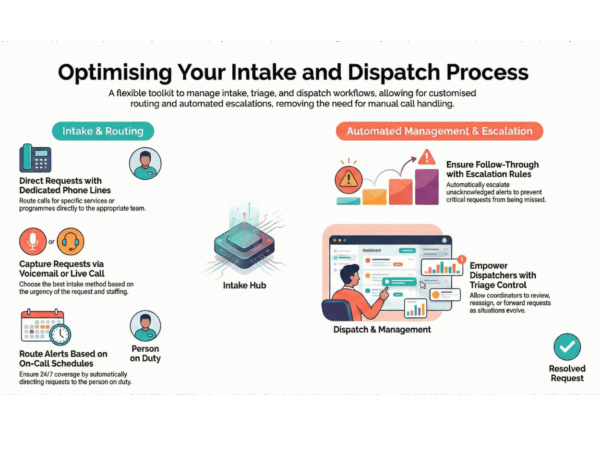
A different operating model, not a different vendor
This comparison is not about replacing people or outsourcing responsibility. It reflects a shift in how organizations choose to handle critical information.
Internal intake, triage, and escalation workflows allow organizations to keep decision-making where it belongs: with people who understand the organization, carry accountability, and are trusted to route requests correctly.
To see how this model works in practice, explore:
👉 Intake, Triage & Dispatch for Urgent Requests