

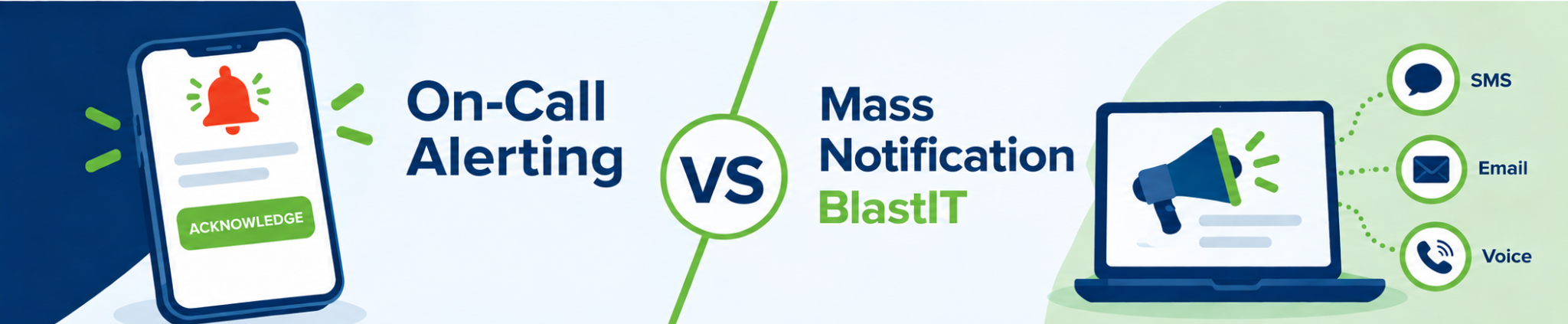
 When an urgent situation occurs, organizations need more than a way to send a message. They need a communication strategy that considers who needs to receive the message, whether they need to take action and how quickly they need to respond.
This is where the difference between on-call alerting and mass notification becomes important.
A critical IT incident, for example, may require an immediate response from a specific on-call engineer or incident response team. A company-wide emergency, severe weather event or major service disruption may require communicating information to hundreds or thousands of employees, customers, residents or other stakeholders.
Both scenarios require reliable communication, but they serve very different purposes.
OnPage’s Incident Alerting and On-Call Management is designed to mobilize the people responsible for taking action. It uses mobile-first critical alerting, on-call schedules, routing rules and escalation policies to direct urgent alerts to the appropriate responder. Organizations can also configure multichannel redundancy through SMS, email and voice calls to create additional ways of reaching responders.
OnPage BlastIT, by comparison, is designed for mass notification. It distributes informational and emergency messages to larger audiences through SMS, email and voice calls without requiring recipients to install the OnPage app.
Understanding the difference between on-call alerting and mass notification can help organizations choose the appropriate communication strategy for different types of events.
What Is On-Call Alerting?
On-call alerting is designed to connect a critical incident with the person or team responsible for responding to it. Rather than broadcasting the same notification to a large population, an on-call alerting system determines who is responsible for responding at that particular time and routes the alert accordingly.
With OnPage’s Incident Alerting and On-Call Management, organizations can use on-call schedules, routing rules and escalation policies to direct critical alerts to the appropriate responder.
For example, if a server fails at 2:00 a.m., the entire IT department may not need to receive the alert. Instead, the notification can be routed to the engineer who is currently on call for that service.
The goal is not simply to deliver information. It is to help ensure a responsible person receives the alert, acknowledges it and takes action.
How Multichannel Notifications Support On-Call Alerting
Reliable on-call alerting may require more than one communication channel.
OnPage uses its mobile app as the primary critical alerting experience, with high-priority push notifications designed to persist until acknowledged and override silent or Do Not Disturb settings when configured appropriately.
Organizations can also add multichannel notification redundancy to provide additional ways of reaching responders.
Available redundancy channels include:
- SMS/text messages: Send an additional notification by text.
- Voice calls: Call the responder as an additional notification method.
- Email: Send an additional copy of the alert by email.
Administrators can configure these options through the OnPage Web Management Console.
Organizations can choose all three redundancy channels, a combination of channels or none, depending on their communication requirements.
Administrators can also customize the time interval before redundant notifications are sent. For example, an organization may configure an additional communication method to be triggered a specified number of minutes after the initial OnPage alert.
This allows organizations to personalize the channels used and when those additional notifications are delivered.
What Is Mass Notification?
Mass notification serves a different purpose.
Instead of identifying and mobilizing the person responsible for resolving an incident, mass notification focuses on distributing information to a larger audience.
OnPage’s mass notification module, BlastIT, allows organizations to distribute informational and emergency communications through:
- SMS
- Voice calls
Recipients do not need to have the OnPage application installed.
Organizations can use BlastIT to communicate with employees, departments, vendors, customers, residents or other groups that need to receive important information.
For example, a business experiencing a major service outage may need to tell employees that a system is temporarily unavailable. A municipality may need to communicate severe weather information to residents. An organization may also need to distribute an emergency announcement across its entire workforce.
In these scenarios, the primary objective is not assigning responsibility for resolving an incident. It is keeping a broader population informed.
On-Call Alerting vs. Mass Notification: The Key Difference
The biggest difference between on-call alerting and mass notification is what the recipient is expected to do after receiving the message.
On-call alerting is action-oriented.
The notification is directed to a responder because that individual or team is responsible for investigating, escalating or resolving an issue.
Mass notification is primarily information-oriented.
The recipients need to know that something has happened, understand how it may affect them or receive instructions and updates related to the situation.
| Feature | OnPage Multichannel Notifications | OnPage BlastIT |
|---|---|---|
| Primary purpose | Critical incident alerting and notification redundancy | Mass notification and large-scale communication |
| Primary audience | Targeted incident responders and on-call personnel | Large groups of recipients |
| Typical recipients | On-call engineers, IT teams, security teams, clinicians and other critical responders | Employees, residents, communities or other broad audiences |
| Communication approach | Reach the appropriate responder through critical alerting with optional redundant channels | Distribute important information to many recipients |
| Notification channels | OnPage’s primary PUSH alerting channel along side, SMS, voice and email as configurable multichannel redundancy options | Designed around broad mass communication channels, like SMS, email and IVR. |
| Customizable channels | Administrators can determine which redundancy channels are enabled | Focused on large-scale message distribution |
| Best suited for | Incidents requiring action from specific responders | Events requiring communication with a large population |
| Example | Alerting the on-call engineer responsible for a critical server outage | Sending an emergency announcement to employees company-wide or residents across a town |
When Should Organizations Use On-Call Alerting?
On-call alerting is best suited to situations where a specific person or team is responsible for taking action.
Common examples include:
- Alerting an on-call engineer about a critical server or application failure
- Notifying IT teams about infrastructure incidents
- Routing cybersecurity incidents to the appropriate response team
- Alerting clinicians or healthcare teams about time-sensitive events
- Notifying technicians about critical equipment failures
- Escalating an incident when the initial responder does not acknowledge it
In these scenarios, notifying more people does not necessarily improve the response.
The priority is getting the alert to the right person at the right time and providing a clear process for acknowledgment and escalation.
OnPage’s Incident Alerting and On-Call Management supports this workflow through on-call schedules, routing and escalation capabilities, alert noise reduction, persistent mobile push alerts and optional multichannel redundancy. The attention-grabbing push alerts can continue to alert until read and override the silent switch.
When Should Organizations Use Mass Notification?
Mass notification is better suited to situations where many people need to receive important information at the same time.
Examples may include:
- Company-wide emergency announcements
- Severe weather notifications
- Office closures and delays
- IT outage communications
- Security or safety announcements
- Campus-wide communications
- Public safety messages
- Operational updates
- Customer notifications
- Communications with vendors or external stakeholders
Because BlastIT delivers messages through SMS, email and voice calls, recipients do not need to install the OnPage application to receive these communications.
This makes mass notification particularly useful when the intended audience extends beyond an organization’s dedicated incident response teams.
Can Organizations Use On-Call Alerting and Mass Notification Together?
Yes. OnPage’s Incident Alerting and On-Call Management and BlastIT can complement each other during the same event because organizations frequently need to communicate with responders and broader audiences simultaneously.
Consider a critical IT outage.
With OnPage’s Incident Alerting and On-Call Management, the incident can be routed to the on-call engineer or response team responsible for restoring the affected service. The responders receive actionable critical alerts and can acknowledge and begin addressing the incident.
Meanwhile, BlastIT can communicate the disruption to a much arger audience.
Employees could receive an SMS explaining that a business application is temporarily unavailable. Customers could receive an important service update. Additional notifications could be distributed as the situation develops.
The two communication workflows remain distinct:
OnPage’s Incident Alerting and On-Call Management mobilizes the people responsible for taking action.
OnPage BlastIT communicates information to the people who need to know.
Using both allows organizations to separate incident response from large-scale communication.
The Bottom Line: Who Needs to Act vs. Who Needs to Know?
The difference between on-call alerting and mass notification ultimately comes down to purpose, audience and expected action.
OnPage’s Incident Alerting and On-Call Management is designed for critical situations where specific responders need to take action. On-call schedules, routing rules and escalation policies help direct alerts to the appropriate responder, while persistent mobile notifications and configurable multichannel redundancy help reinforce critical alert delivery.
OnPage BlastIT is designed for situations where organizations need to distribute information to a much broader audience through SMS, email and voice calls.
During the same event, organizations may need both.
On-call alerting helps answer:
Who needs to act?
Mass notification helps answer:
Who needs to know?
Together, OnPage’s Incident Alerting and On-Call Management and BlastIT allow organizations to address both sides of critical communication without treating every recipient or every message the same way.
Frequently Asked Questions
What is the difference between on-call alerting and mass notification?
How do multichannel notifications support OnPage’s Incident Alerting and On-Call Management?
Multichannel notifications provide additional notification paths alongside OnPage’s mobile alerting. Organizations can configure SMS, email and voice-call redundancy according to their communication requirements.
Administrators can select which channels are enabled and configure the time interval before redundant notifications are sent.
Do organizations have to enable SMS, email and voice redundancy?
Can organizations use OnPage’s Incident Alerting and On-Call Management and BlastIT together?
About The Author


