IT incidents do not follow a 9-to-5 schedule. A server can go down overnight, a critical application can fail on a weekend, or a high-priority support ticket can arrive when the IT team has already left the office. For IT teams, the challenge goes beyond simply providing after-hours IT support. They need a reliable on-call … Continued
TL;DR Key Takeaways AI logging tools capture prompts, responses, errors, token usage, and execution traces to help teams troubleshoot AI applications. Langfuse is ideal for open-source LLM logging, while LangSmith is best suited for LangChain and LangGraph applications. Choosing the right AI logging tool depends on integrations, debugging capabilities, pricing, and security. While AI logging … Continued
After-hours calls can create missed messages and send urgent issues to the wrong clinician. For private medical practices, that risk grows when call answering and on-call escalation rely on the same loosely defined workflow. Answering service receives an inbound call, captures information, and categorizes the request. On-call routing identifies the responsible clinician, delivers the message, … Continued
Managing a growing IT environment requires more than reacting to problems as they appear. IT teams and managed service providers (MSPs) need continuous visibility into endpoints, servers, networks and other infrastructure so they can identify potential issues, perform maintenance and resolve problems remotely. That is where remote monitoring and management (RMM) software comes in. RMM … Continued
Pharmacists manage much more than dispensing medications. Throughout the day, they may be processing prescriptions, communicating with healthcare providers, assisting patients and coordinating with other pharmacy staff, all while managing a steady flow of incoming calls. For pharmacies that accept prescriptions by phone, those calls add another important communication workflow to an already busy environment. … Continued
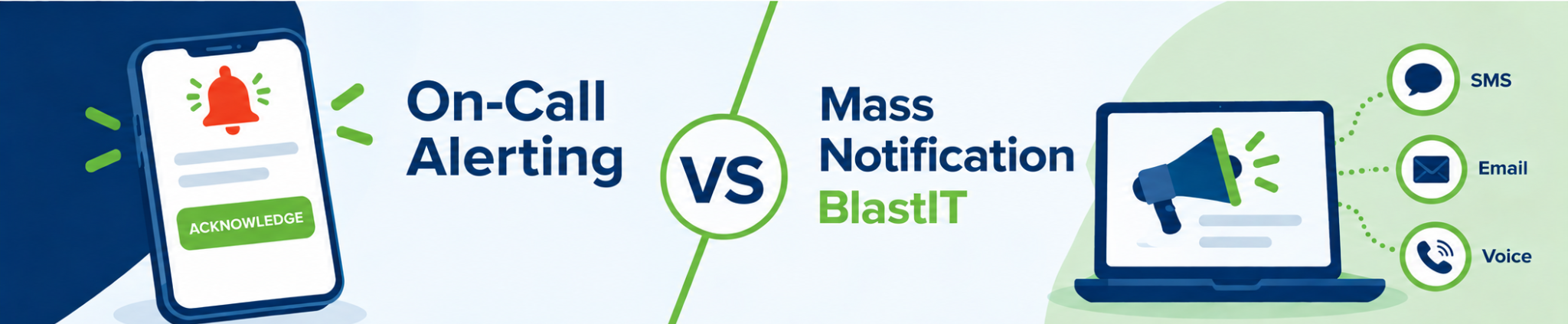
When an urgent situation occurs, organizations need more than a way to send a message. They need a communication strategy that considers who needs to receive the message, whether they need to take action and how quickly they need to respond. This is where the difference between on-call alerting and mass notification becomes important. A … Continued
IT Ops teams face two failures that pull in opposite directions: responders interrupted so often that they stop reacting, and a truly critical alert lost inside that same flood. Alert noise and alert fatigue describe those two problems, and treating them as one usually makes both worse. This article shows how to reduce interruptions without … Continued
A missed alert at 3 a.m. can turn a minor outage into a full-blown SLA breach. For IT Ops teams and MSPs, the on-call alerting tool you choose directly affects how fast you detect and resolve critical incidents. That decision just got more urgent, because one of the most popular tools in this space is … Continued
Verizon is decommissioning its `vtext.com` email-to-text gateway by March 31, 2027, and some senders may lose access even earlier (Verizon shutdown notice) [1]. If your monitoring tools, ITSM platform, or custom scripts route alerts through `@vtext.com` or `@vzwpix.com`, that pipeline is on borrowed time. For IT Operations teams, MSPs, DevOps and SRE engineers, and healthcare … Continued
Modern IT incidents don’t stick to a 9-to-5 schedule. System failures, security breaches, and performance degradations can happen at any time, and today’s distributed teams must respond instantly, wherever they are. The ability to receive, acknowledge, and manage incidents directly from a smartphone is no longer a luxury, it’s a core requirement for effective incident … Continued